Introduction
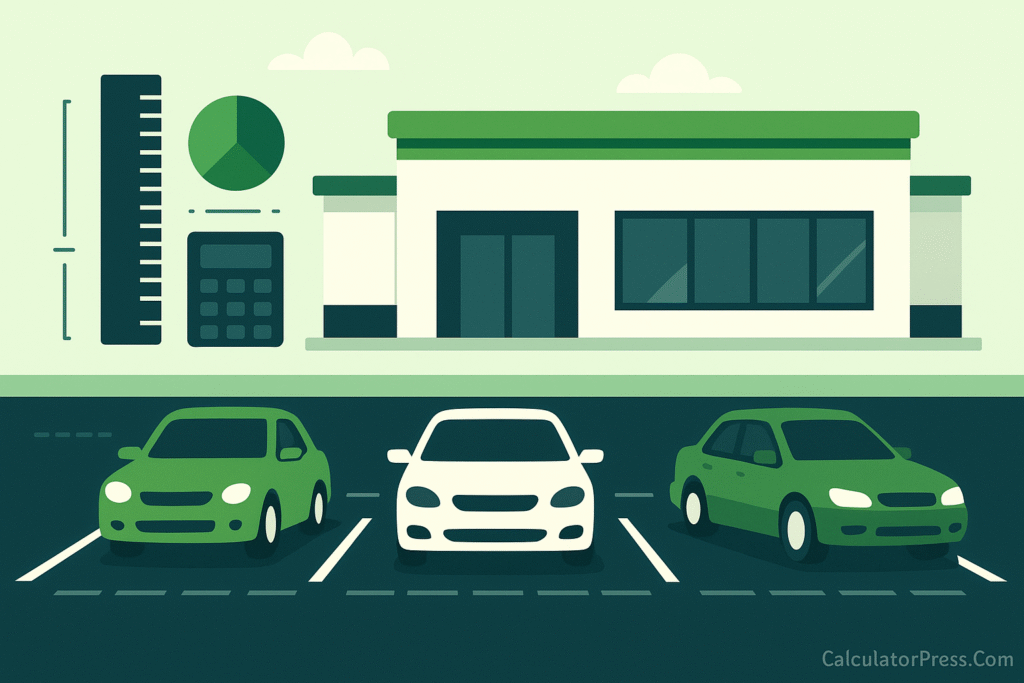
Parking planning is one of the most important—and often overlooked—elements of real estate development, commercial site design, and building management. Whether you’re evaluating a property, planning a new structure, expanding a commercial space, or analyzing the feasibility of a business location, understanding how to calculate parking ratio is essential for meeting user needs and staying compliant with local regulations.
A parking ratio represents the number of parking spaces available relative to the size or usage of a building. It helps planners determine whether a property can handle peak traffic, ensures safety and accessibility, and influences customer satisfaction and business performance. While the idea sounds simple, parking ratio calculation requires precision. Miscalculations can lead to overcrowded lots, code violations, or unused space.
Fortunately, tools like a Parking Ratio Calculator make it easy to calculate parking ratio accurately without manual math or guesswork. If you’re managing multiple real estate evaluations, researching development potential, or simply want a clear understanding of parking requirements, a calculator becomes an invaluable resource.
For more helpful calculators and planning tools, you can also explore additional resources on our homepage at CalculatorPress.com.
Parking Ratio Calculator
This Parking Ratio Calculator provides a fast and precise way to determine how many parking spaces a building needs based on industry standards, usable floor area, and zoning guidelines. Instead of manually working through formulas, you can enter your building size, the number of current or required spaces, and your property type. The calculator instantly shows the parking ratio and helps you compare it with standard requirements for retail stores, offices, restaurants, hotels, and more.
Use this tool anytime you need accurate numbers for feasibility studies, tenant planning, investment evaluation, or compliance documentation.
Parking Ratio Calculator
What Is a Parking Ratio?
A parking ratio is a numerical value that indicates the number of parking spaces available for a specific building size. In commercial real estate, it is usually expressed as the number of parking spaces per 1,000 square feet of gross leasable area (GLA).
For example:
A ratio of 4.0 means there are 4 parking spaces for every 1,000 square feet of building area.
This ratio is one of the most important metrics used by developers, property owners, local governments, and businesses because it affects both usability and legal compliance. While homeowners rarely think about parking ratios, commercial buildings rely on them heavily to meet customer, employee, and tenant needs.
Parking ratio is different from a standard “parking requirement.” A requirement is typically set by zoning laws, while a ratio is a calculation that shows whether the property meets or exceeds those laws.
Why Parking Ratios Matter in Real Estate Development
Understanding and calculating parking ratios is crucial for many reasons:
1. Tenant and Customer Needs
Retailers rely on convenient parking to attract shoppers. A building with insufficient parking may discourage customers and reduce sales.
2. Zoning Code Compliance
Cities often enforce minimum or maximum parking requirements to control congestion and encourage walkability. Proper ratios ensure compliance.
3. Property Value and Marketability
Properties with ideal parking ratios tend to be more attractive to investors and tenants. A well-designed parking area boosts real estate appeal.
4. Space Utilization and Efficiency
Too much parking wastes valuable land; too little causes traffic issues. Calculating the correct ratio ensures efficient land use.
5. Business Performance
Restaurants, medical clinics, gyms, and retail stores all depend heavily on predictable parking availability for peak-hour operations.
How to Calculate Parking Ratio Step by Step
To understand how to calculate parking ratio, follow the standard industry method used in commercial real estate:
Parking Ratio Formula
Parking Ratio=(Number of Parking SpacesBuilding Size (sq ft))×1000\text{Parking Ratio} = \left( \frac{\text{Number of Parking Spaces}}{\text{Building Size (sq ft)}} \right) \times 1000Parking Ratio=(Building Size (sq ft)Number of Parking Spaces)×1000
This formula expresses the number of parking spaces per 1,000 square feet of building area.
Step-by-Step Breakdown
Step 1: Measure the Building Area
Determine the gross leasable area (GLA). For example, an office building may be 40,000 sq ft.
Step 2: Count the Number of Parking Spaces
Include standard spaces, ADA spaces, and employee spaces.
Step 3: Plug the Values Into the Formula
If you have:
- 40,000 sq ft building
- 160 parking spaces
Then: Parking Ratio=(16040000)×1000=4.0\text{Parking Ratio} = \left( \frac{160}{40000} \right) \times 1000 = 4.0Parking Ratio=(40000160)×1000=4.0
This means the property has 4 parking spaces per 1,000 sq ft, which is ideal for typical office buildings.
Step 4: Compare with Standards
Different industries require different ratios. For example:
- Retail may need 4.5–5.0
- Restaurants often need 10–15
- Medical offices may require 5–6
Step 5: Adjust for Peak Usage
Consider:
- Weekend vs. weekday traffic
- Customer vs. employee needs
- Shared parking agreements
These factors ensure your calculated ratio aligns with real-life usage.
Parking Ratio Standards by Property Type
Different industries follow different standards because foot traffic varies greatly.
1. Retail Stores
Retail requires moderate-to-high parking availability. Typical ratio:
- 4.0–5.0 spaces per 1,000 sq ft
Large box retailers may require even more.
2. Restaurants
Restaurants experience high turnover and peak demand at meal times.
- 10–15 spaces per 1,000 sq ft
This includes staff and customer parking.
3. Office Buildings
Office staff usually stay for long durations.
- 3.0–4.0 spaces per 1,000 sq ft
In busy metropolitan areas, the ratio may be lower due to public transit.
4. Industrial / Warehouse Facilities
These buildings need little customer parking.
- 1.0–2.0 spaces per 1,000 sq ft
Truck loading areas often replace traditional parking.
5. Hotels and Lodging
Hotels require parking per room instead of per square foot.
- 0.75–1.3 spaces per guest room
Hotels with conference centers may require more.
6. Multi-Family Residential Properties
Residential parking uses “spaces per unit,” such as:
- 1.0–2.0 spaces per apartment unit
Local zoning usually determines the standard.
Factors That Affect Parking Ratio Requirements
Several variables influence parking needs beyond building size.
1. Foot Traffic and Customer Volume
A high-traffic business, such as a gym, requires more parking than a storage warehouse.
2. Zoning Regulations
Cities set minimum and sometimes maximum parking requirements. For example, the U.S. Department of Transportation provides guidelines for parking planning and urban mobility, which local governments often reference.
3. Public Transportation Access
Buildings near bus or train stations generally need fewer parking spaces.
4. Shared Parking Availability
Shared parking agreements between businesses with different peak times can reduce the required ratio.
5. Peak-Hour Usage Patterns
Restaurants, schools, and medical offices experience peak congestion.
6. Urban vs. Suburban Location
Urban areas rely more on walkability and public transit, lowering parking requirements.
Manual vs. Calculator Method: Which Is Better?
You can calculate parking ratios manually using the standard formula. However, using a Parking Ratio Calculator offers several advantages:
Accuracy
Manual math errors can lead to incorrect ratios and compliance issues.
Time-Saving
A calculator instantly processes data, saving hours in planning.
Consistency
Great for planning multiple properties or large portfolios.
Convenience
Developers, architects, and planners can evaluate options in seconds.
While manual calculation helps you understand the formula, the calculator method is faster and far more practical for real-world planning.
Common Mistakes When Calculating Parking Ratio
Mistakes are common when planning parking layouts. Here are errors to avoid:
1. Misinterpreting Gross vs. Usable Square Footage
Always use gross leasable area (GLA) unless zoning specifies otherwise.
2. Forgetting Employee Parking
Employee spaces must be included, especially for restaurants and clinics.
3. Not Reviewing Local Codes
Zoning rules can override industry standards.
4. Assuming One Ratio Fits All
Every property type and city is different.
5. Ignoring ADA Requirements
ADA-compliant spaces are mandatory and part of the calculation.
Best Practices for Improving Parking Efficiency
Improving parking efficiency can maximize land value and enhance user experience.
1. Shared Parking Strategies
Businesses with opposite peak times can share spaces.
2. Use Smart Parking Technology
Sensors and digital signage improve flow and reduce congestion.
3. Efficient Lot Design
Better traffic lanes, striping, and signage increase capacity.
4. Add Bike and EV Charging Stations
Modern visitors appreciate alternative transportation options.
5. Improve Pedestrian Zones
Safe walkways encourage better space utilization and reduce vehicle hazards.
FAQ About Parking Ratio
What is a parking ratio?
A parking ratio measures how many parking spaces exist per 1,000 sq ft of building area.
Why do some buildings have higher ratios?
High-traffic businesses like gyms, restaurants, and medical offices require more parking.
Do residential areas follow parking ratios?
Yes, but ratios are based on “spaces per unit,” not building size.
What is a good parking ratio?
It depends on property type. Offices average 3–4; retail averages 4–5.
Can I calculate parking ratio manually?
Yes, but a calculator is faster, more accurate, and easier for multiple projects.
Does parking ratio affect property value?
Absolutely. Adequate parking improves usability, compliance, and tenant appeal.
Conclusion
Learning how to calculate parking ratio is an essential skill for real estate developers, business owners, property investors, planners, and anyone involved in evaluating commercial buildings. Understanding the formula helps you determine whether a building’s parking capacity is suitable for its function. Meanwhile, using a Parking Ratio Calculator ensures accuracy, saves time, and prevents costly mistakes.
Whether you’re assessing a small retail shop, planning a large office complex, or reviewing zoning compliance, calculating parking ratio correctly ensures smooth operations and a better user experience. Use this guide and our calculator to make informed decisions and plan your next project with confidence.